

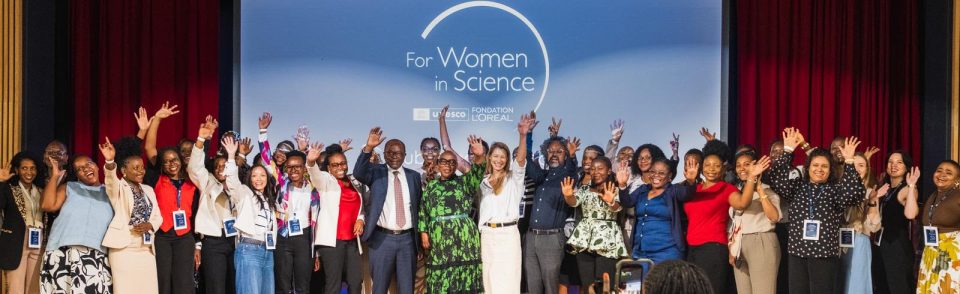
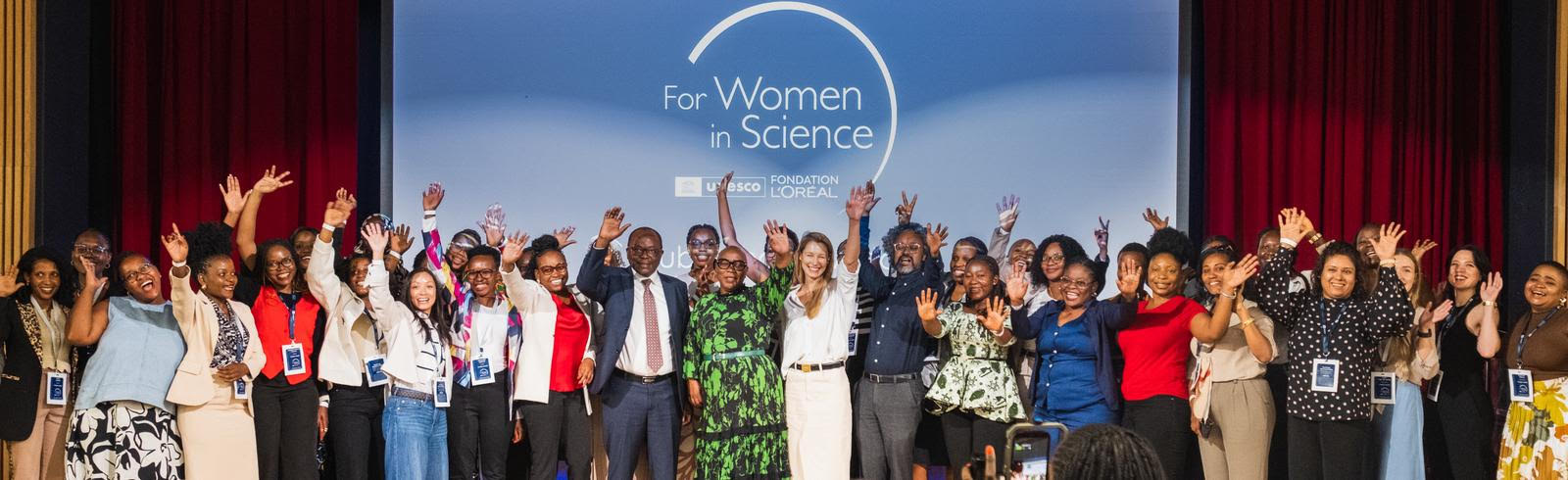
The Foundation L’Oréal and UNESCO announced the 2025 laureates of the L’Oréal-UNESCO For Women in Science Young Talents Sub-Saharan Africa Awards. These awards celebrate 30 exceptional young scientists — 25 PhD candidates and 5 postdoctoral researchers from 18 Sub‑Saharan African countries — recognized for the excellence of their research, their dedication to addressing the continent’s challenges, and their determination to inspire future generations of women scientists.
Selected from more than 550 applications, the laureates were chosen by a jury of 10 scientists, chaired by Professor Priscilla Baker, chemistry professor at Western Cape University in South Africa, who received herself the 2025 International L’Oréal‑UNESCO For Women in Science Award. The awardees represent diverse fields, including life and environmental sciences, material sciences, engineering and technology, and formal sciences.
Their research contributes directly or indirectly to addressing key continental and global challenges such as food security, public health, sustainable development, and inclusive digital transformation.
Progress towards gender parity in scientific research in Sub‑Saharan Africa
Across Sub-Saharan Africa, several countries are making meaningful progress toward a more inclusive scientific ecosystem. According to UNESCO’s latest report, Kenya for example has made remarkable progress, increasing the proportion of women researchers by 12 percentage points in 10 years — from 25.7% in 2013 to 38.4% in 20231. This positive trend demonstrates growing momentum for women scientists.
Women are also increasingly represented in higher education, representing 58% of graduates in Namibia and 60% in South Africa. Despite this progress, women scientists still make up only 1 in 3 researchers in Sub-Saharan Africa, as it is the case globally. It is therefore crucial to continue taking action to help foster a new generation of young African women scientists.
Young Talents Award: A renewed commitment to advancing excellence among women scientists
In the face of the challenges facing Africa, this year’s Young Talents laureates contribute actively to placing science at the heart of development models across the continent. For example, Margaret Murage is recognized for her work on new cancer treatments, while Ramal Cyrielle Ndougonna is awarded for using genomic data to identify cassava varieties that are disease‑resistant, high‑yielding, drought‑tolerant, and nutritionally enhanced, all crucial for food security in Africa.
Breaking the glass ceiling and shaping the future of science
“We believe that the future of science in Sub‑Saharan Africa relies on recognizing and supporting women scientists. Through the L’Oréal‑UNESCO For Women in Science Sub-Saharan Africa Young Talents Awards, we showcase women scientists who are pioneering sustainable change and delivering solutions for Africa and the world,” said Pauline Avenel‑Lam, Executive Director of The Fondation L’Oréal.
“UNESCO champions women researchers at the heart of Africa’s scientific transformation. The L’Oréal–UNESCO For Women in Science Sub-Saharan Africa Young Talents Awards show how partnership can open doors, amplify voices, and accelerate impact. By celebrating these remarkable young researchers, we reaffirm our commitment to their success and to Africa’s sustainable and equitable future,” added Lidia Brito, Assistant Director-General for Natural Sciences at UNESCO.
A growing community of more than 270 African women scientists
For over 15 years, the L’Oréal-UNESCO For Women in Science Young Talents Sub-Saharan Africa programme has supported more than 270 women scientists from over 35 countries.
Laureates receive financial grants (€10,000 for PhD candidates, €15,000 for postdoctoral researchers) and trainings in leadership, scientific communication, and career development.
They also join a global network of more than 4,700 women scientists since the international programme’s creation in 1998.
About the Fondation L’Oréal
The Fondation L’Oréal supports and empowers women to shape their future and make a difference in society. It focuses its action on two main areas: science and beauty.
Science: encouraging women’s scientific excellence and inspiring future generations.
The Fondation L’Oréal is committed to supporting women scientists at every stage of their careers, from sparking vocations at a young age to recognizing excellence in established researchers. This commitment translates into an intergenerational approach and dedicated programmes.
In partnership with UNESCO, Fondation L’Oréal has run the international For Women in Science programme since 1998. This programme aims to accelerate the careers of women scientists, remove the obstacles they face, and inspire younger generations to embrace scientific careers. To date, the programme has supported more than 4,700 researchers from over 140 countries, promoting scientific excellence and encouraging many young women to pursue scientific studies.
The Fondation L’Oréal also invests in the future of women in science through its For Girls in Science programme. This programme aims to inspire scientific vocations in young girls by raising their awareness of the scientific challenges of tomorrow and introducing them to inspiring female role models. The goal is to support and encourage the next generation of female scientists, giving them the keys to succeed in scientific fields.
Beauty: restoring self-esteem and promoting professional integration.
Convinced that beauty contributes to the process of rebuilding lives, the Fondation L’Oréal helps vulnerable women to improve their self-esteem through free socio-aesthetics treatments. These treatments help restore their self-esteem and help them regain confidence. At the same time, the Fondation L’Oréal promotes the professional integration of vulnerable women through training in beauty professions.
More than 170,000 women have benefitted from socio-aesthetics treatments and more than 67,000 women have participated in the trainings.
About UNESCO
With 194 Member States, the United Nations Educational, Scientific and Cultural Organization contributes to peace and security by leading multilateral cooperation on education, science, culture, communication and information. Headquartered in Paris, UNESCO has offices in 54 countries and employs over 2300 people. UNESCO oversees more than 2000 World Heritage sites, Biosphere Reserves and Global Geoparks; networks of Creative, Learning, Inclusive and Sustainable Cities; and over 13 000 associated schools, university chairs, training and research institutions. Its Director-General is Audrey Azoulay.
“Since wars begin in the minds of men, it is in the minds of men that the defenses of peace must be constructed” – UNESCO Constitution, 1945.
SUPPLIED.