

The Cape Union Mart Group has positioned itself at the forefront of sustainable retail in Southern Africa through a comprehensive approach to responsible sourcing that delivers tangible environmental, social, and economic benefits while elevating product performance and quality. Environmental responsibility forms a non-negotiable component of the Group’s supplier evaluation and selection process, serving as a key pillar in future-proofing its supply chain. The company employs a combination of internationally recognised standards and internal sustainability benchmarks to assess environmental performance, prioritising suppliers certified by credible third-party organisations such as OEKO-TEX, Bluesign, Global Recycled Standards (GRS), Responsible Down Standards (RDS), and Responsible Wool Standard (RWS). These certifications ensure that materials and manufacturing processes meet strict environmental and chemical-safety standards.
The Group’s participation in the EU-funded UNEP InTex project underscores its commitment to data-driven enhancement of product sustainability. Through this initiative, a Product Environmental Footprint was conducted on a locally produced puffer jacket in 2024, establishing a baseline for measuring and monitoring environmental-performance improvements.
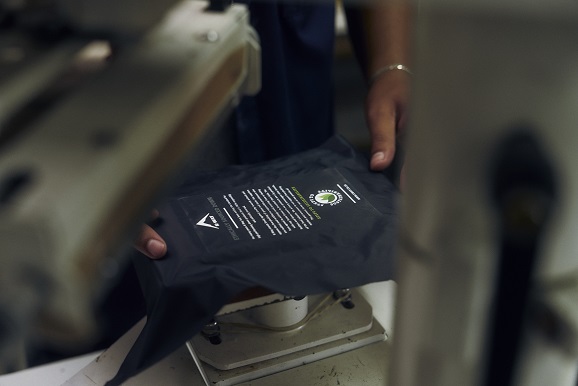
Local procurement forms another cornerstone of the Group’s sustainable sourcing strategy. Whenever feasible, the company prioritises regional or local suppliers to reduce transport-related emissions whilst supporting the South African textile industry. With 33 per cent local contribution across operations and an ambitious goal to produce 65 per cent of products locally by 2030, the Group strengthens South African manufacturing while reducing supply-chain vulnerabilities. By actively coaching suppliers to improve their sustainability and business practices, the Group creates a more robust and capable local supply base, and two executive committee members serve on the Cape Clothing Cluster executive committee, steering collaborative efforts to grow local production.
Sustainable sourcing is never at the expense of quality or comfort. Before any sustainable fabric enters the range, it undergoes comprehensive laboratory testing, including Martindale abrasion resistance, pilling, tensile strength, and hydrostatic head assessments. This rigorous pre-approval process ensures that recycled synthetics match or surpass the strength, abrasion resistance, and longevity of virgin fibres. Production-quality monitoring protocols at The Group’s manufacturing facilities ensure consistency through bulk lot testing, visual inspections at the fabric distribution centre, and Acceptable Quality Limit standards for defect assessment. When materials fail quality assurance, they are quarantined and suppliers are asked to provide corrective-action plans.
Field testing forms an integral part of the quality-validation process. Product teams, ambassadors, and technical staff wear-test prototypes in real-world conditions, providing feedback on comfort, durability and performance over time. This comprehensive approach identifies potential failure points before large-scale rollouts, ensuring that sustainable materials deliver the performance customers expect from brands like K-Way, where outdoor functionality is non-negotiable.
These rigorous testing and performance-guarantee processes mean that the pursuit of sustainability has enhanced rather than compromised product innovation, quality and durability. Multi-functional performance features including moisture wicking, thermal regulation, and breathability are engineered into sustainable materials. Innovative PFC-free coatings and finishes enable customers to experience lighter, more breathable garments without sacrificing weather protection, proving that environmental responsibility drives rather than constrains technical advancement.
The Group stays abreast with global innovation in material design, and K-Way in particular has pioneered the adoption of high-performance, low-impact materials, including Polartec recycled performance fleece, which offers increased softness and thermal stability compared to virgin polyester, and GRS-certified recycled polyester stretch softshells made from Jairen yarn derived from used clothes and textiles, which combine durability, flexibility and water repellence with significantly reduced environmental impact.
In fact, half of the K-Way range now incorporates sustainable materials. A collaboration with Sealand Gear has produced a sustainable collection using Bureo recycled nylon made from fishing nets recovered from marine environments, alongside creative repurposing of deadstock and aged fabrics. The adoption of Primaloft insulation, made from 100 per cent post-consumer recycled polyester, provides exceptional warmth-to-weight ratio, breathability, and compressibility in K-Way technical outerwear, while Gerber & Co’s 100 per cent needle felt wool insulation is a fully biodegradable, locally sourced 100% wool product which is thermoregulating and moisture wicking – ideal for warmth with a low ecological footprint.
This rigorous approach to sourcing and standards has made the Cape Union Mart Group justifiably proud of its product quality. In a culture of disposable garments, the Group remains committed to helping its products go the distance and offer years of style and functionality. The Group runs a dedicated Repair Centre – which it operates at below cost – and offers a generous guarantee on shoes and apparel.
By demonstrating that environmental responsibility, social impact, and commercial success are mutually reinforcing objectives, the Cape Union Mart Group provides a blueprint for sustainable retail that benefits all stakeholders. The Group’s longstanding relationships with partners who share its values around sustainability, innovation, and continuous improvement, reinforce Cape Town’s position as a centre of excellence for responsible manufacturing while setting new standards for what retail can achieve when purpose drives procurement.
For more on the Group’s approach to sustainability, visit https://www.capeunionmart.co.za/page/sustainability
Did you know? Gerber & Co’s 100 per cent needle felt wool insulation is a fully biodegradable, locally sourced 100% wool product which is thermoregulating and moisture wicking – ideal for warmth with a low ecological footprint.
Did you know? Cape Union Mart’s collaboration with Sealand Gear has produced a sustainable collection using Bureo recycled nylon made from fishing nets recovered from marine environments, alongside creative repurposing of deadstock and aged fabrics.
Did you know? With 33 per cent local contribution across operations and an ambitious goal to produce 65 per cent of products locally by 2030, the Cape Union Mart Group is committed to strengthening South African manufacturing.
Did you know? Field testing forms an integral part of the quality-validation process at Cape Union Mart Group. Product teams, ambassadors, and technical staff wear-test prototypes in real-world conditions, providing feedback on comfort, durability and performance over time.
SUPPLIED.