
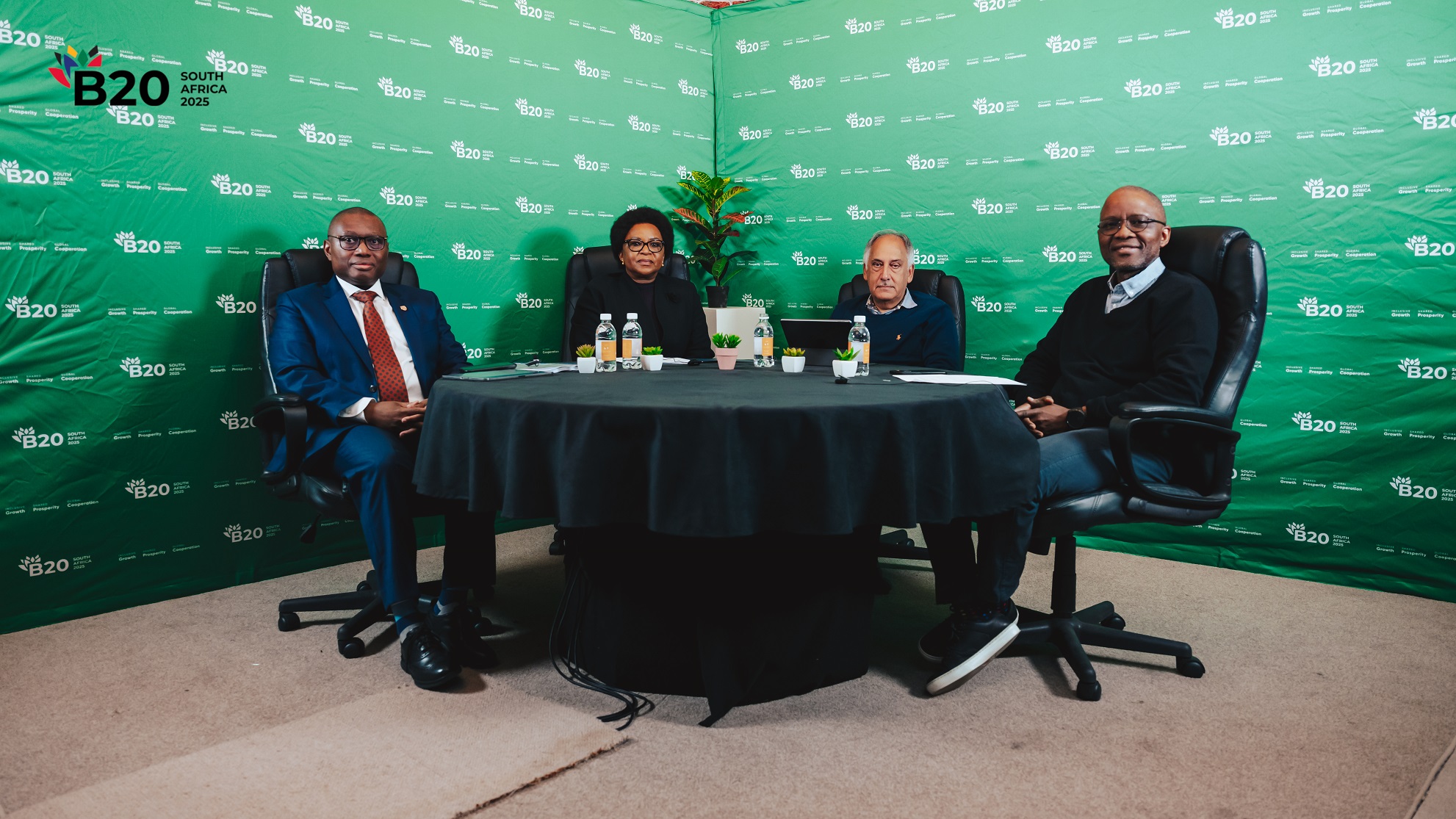
B20 South Africa on Tuesday highlighted the critical need for global cooperation as geopolitical fragmentation threatens to derail progress on pressing economic challenges. At a high-level briefing, business leaders and select task force chairs presented emerging policy recommendations aimed at fostering inclusive growth, combating corruption and closing Africa’s infrastructure funding gap ahead of their official handover to the G20 Presidency in September.
An African B20 has never been more important
Cas Coovadia, B20 South Africa Sherpa said: “Africa’s voice in the G20 is not just necessary but we must lead, not just occupy a seat at the table. This demands full collaboration with task force leaders across G20 nations, alongside local and international business advisory councils, to drive meaningful progress.”
The policy recommendations will be presented to the G20 Presidency in early September, ahead of the B20 South Africa Summit in Johannesburg from 18–20 November 2025.
Corruption is a $120 Billion drain on Africa’s prosperity
Ruwayda Redfearn, Chair of the Integrity and Compliance Task Force, highlighted the devastating impact of corruption on Africa’s growth. “The Africa Union estimates that up to $120 billion is lost annually to corruption, funds that are often borrowed for development, only to be stolen. This theft robs our people of schools, hospitals and resilient infrastructure while eroding trust in institutions.”
Redfearn outlined the Task Force’s focus: leveraging technology to strengthen whistleblower protections, embedding anti-corruption measures in climate finance, and fostering collective action. “Integrity is not a compliance checkbox. It is the foundation of economic resilience as without it, sustainable growth is impossible.”
Africa’s $85 Billion Infrastructure Gap
Sim Tshabalala, Chair of the Finance and Infrastructure Task Force, stressed the need for urgent investment. “Africa requires $170 billion annually for infrastructure but mobilises only half. This $85 billion shortfall stifles growth while the world faces a $500 billion global gap. We cannot afford inaction.”
Tshabalala proposed solutions, including streamlining regulations, reassessing risk weights on infrastructure financing, and boosting project preparation. “Strategic coordination between governments and investors is non-negotiable. Africa’s potential is vast but unlocking it demands bold reforms and global solidarity.”
A divided global trade landscape calls for coordinated solutions
Busi Mabuza, Chair of the Trade and Investment Task Force, warned against rising protectionism. “Global trade faces a crisis where tariffs and a weakened WTO threaten $366 billion in trade losses. For Africa, which accounts for just 3% of global trade, this is catastrophic.”
Mabuza called for a “New Deal for Africa”, accelerating the African Continental Free Trade Area (AfCFTA), harmonising investment rules and ensuring climate policies do not exclude developing nations. “We must redesign trade to be inclusive, sustainable and resilient. The alternative is deeper inequality.”
The bottom line needs cooperation over fragmentation
Mxolisi Mgojo, B20 South Africa Co-Chair,emphasised that South Africa’s B20 presidency is not just a national milestone but Africa’s moment to shape global economic policy. “In a fragmented world, Africa can be a bridge, balancing global tensions while driving inclusive growth,” he said.
Mgojo highlighted that Africa’s voice is critical in addressing shared challenges such as energy, food security and digital access. “We must move from potential to progress. This demands cooperation across business, government and civil society. In today’s world, collaboration is not idealistic, it is essential.”
About B20 South Africa:
The Business 20 (B20), the official G20 dialogue forum for the global business community, is set to convene in South Africa in 2025 under the leadership of Business Unity South Africa (BUSA). This marks a historic milestone as the first B20 summit hosted by an African nation, reinforcing the continent’s growing role in shaping global economic policy.
The B20 serves as a vital platform for G20 business leaders to develop actionable policy recommendations, which are presented to the G20 to foster sustainable and inclusive economic growth. The B20 Summit will bring together up to 3,000business leaders, heads of international organisations, public policy experts from approximately 25 countries, fostering high-level dialogue and collaboration.
Under the theme Inclusive Growth and Prosperity Through Global Cooperation, B20 South Africa 2025 will focus on advancing policies that promote equitable economic development, strengthen international partnerships and address pressing global challenges.
B20 South Africa Sponsors:
- Lead: ABSA Group, Anglo American, Standard Bank, Sanlam Allianz
- Platinum: Mastercard, Nestle, Rand Merchant Bank
- Gold: Bidvest, Naspers, Sanofi, Telkom, Visa
- Silver: Bayer, Chemical & Allied Industries’ Association (CAIA), Coronation, Industrial Development Corporation (IDC), Johannesburg Stock Exchange (JSE), MTN, Old Mutual, Remgro, Sappi and Kwikot
- Development: Aprio Group, Nedbank, SAB, Sasol, Standard Bank
For more information, visit: http://b20southafrica.org
INFO SUPPLIED.