
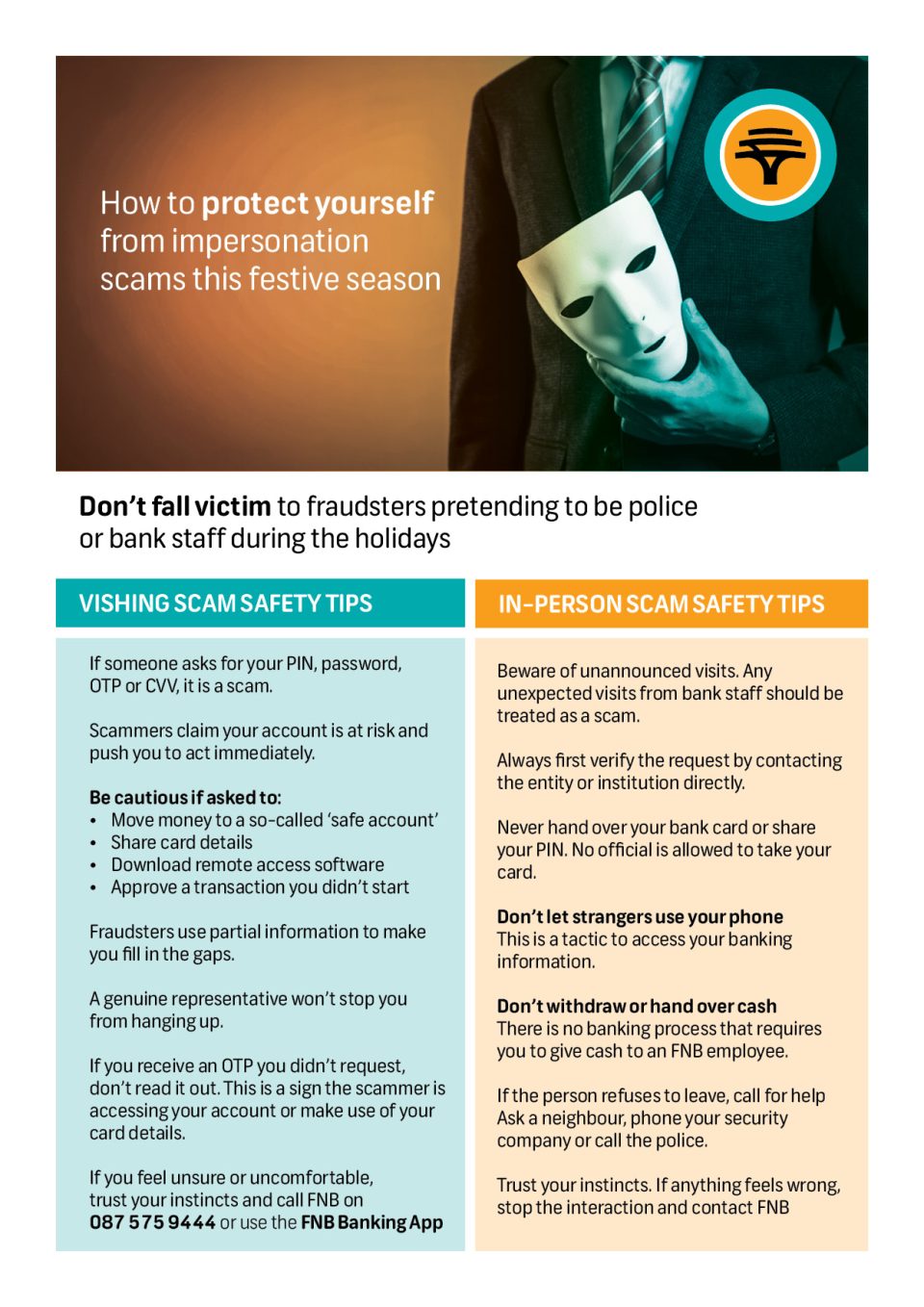
Don’t fall victim to fraudsters pretending to be police or bank staff during the holidays
The festive season is meant to be a time for family, celebration, and well-earned rest. However, with criminals becoming bolder and more active, it can also be a period of heightened financial risk. While many South Africans are distracted by year-end commitments that come along with this period, fraudsters also take advantage of unsuspecting and vulnerable people by impersonating various officials through phone calls and even home visits.

“Their goal is simple,” says Chris Boxall, FNB’s head of Card Transact, Industry and Fraud Detection. “They want to confuse, pressure, and mislead customers into handing over personal information, bank cards, or money.”
These scams often target people who feel unsure about banking processes. Fraudsters use convincing language, as well as fear and urgency, to push victims into acting quickly. “Knowing how these scams work and understanding what a legitimate bank representative will never do can help customers protect themselves and their families,” Boxall says.
How phone-based vishing scams usually work
Most vishing scams begin with a surprise call claiming there is a problem on the customer’s account. Scammers create panic and insist that action must be taken immediately. They ask for sensitive information or instruct customers to move money for supposed safety.
Boxall warns that legitimate FNB staff will never ask for a PIN, password, CVV or OTP. They will also never ask customers to move money to protect it. “If the call feels rushed or suspicious, hang up and call the bank using the number on the back of your card or on the FNB Banking App,” he says.
How in-person impersonation scams work
Criminals also visit homes pretending to be bank employees or other officials. “These visits often target the elderly, the sickly, or people who may feel obligated to open the door,” says Ettienne Fourie, Head of Fraud for Retail at FNB.

Scammers typically claim they need to check a bank card, resolve an account problem, collect a card for security reasons, or ask to use your phone. None of these actions are part of any legitimate banking process.
Fourie explains that bank staff only visit customers in person in very limited, controlled circumstances. “Branch Advisors may visit vulnerable customers at home, in old-age homes, or in hospital, but only in exceptional cases and never without prior arrangement.”
He adds that the bank will never send a Branch Advisor to a customer’s residence without a formal request from the customer, their caregiver, or legal guardian. Any approved visit is arranged in advance, confirmed with all parties, and conducted under strict operational and security protocols, with some visits requiring branch management approval.
“Anyone arriving unannounced, requesting entry, bank cards, PINs, or access to a customer’s phone should be treated as a scammer,” Fourie says. “This impersonation is not limited to banks. FNB has also seen criminals pose as police officers, SARS officials, and courier companies.”
| VISHING SCAM SAFETY TIPS | IN-PERSON SCAM SAFETY TIPS |
| 1. Never share your PIN, password, OTP or CVV. If anyone asks for these, it’s a scam. 2. If anyone claims you should act immediately because your account is at risk, call your bank to verify. 3. Be cautious if asked to: § Move money to a so-called ‘safe account’ § Share card details § Download remote access software § Approve a transaction you didn’t start 4. Fraudsters use partial information to make you fill in the gaps. Never share personal or banking details with anyone. 5. A genuine representative won’t stop you from hanging up. 6. If you receive an OTP you didn’t request, don’t read it out. This is a sign the scammer is accessing your account or make use of your card details. 7. If you feel unsure or uncomfortable, trust your instincts and call FNB on 087 575 9444 or use the FNB Banking App | 1. Beware of unannounced visits. Any unexpected visits from bank staff should be treated as a scam. 2. Always first verify the request by contacting the entity or institution directly. 3. Never hand over your bank card or share your PIN. No official is allowed to take your card. 4. Don’t let strangers use your phone This is a tactic to access your banking information. 5. Don’t withdraw or hand over cash There is no banking process that requires you to give cash to an FNB employee. 6. If the person refuses to leave, call for help Ask a neighbour, phone your security company or call the police. 7. Trust your instincts. If anything feels wrong, stop the interaction and contact FNB |
Protecting elderly and vulnerable customers
Families and caregivers can reduce the risk by regularly checking in, saving trusted numbers on loved ones’ phones, and encouraging them to talk openly about unusual calls or visits.
“Customer awareness is one of the strongest defences against fraud,” says Boxall. “Criminals rely on secrecy and fear. Slowing things down takes away much of their power.”
If you suspect a scam
Report suspicious calls or visits through the Security Centre on the FNB Banking App or by calling 087 575 9444. Early reporting helps prevent further incidents and supports ongoing fraud detection efforts.
Staying alert and informed is the most effective way to protect yourself and your loved ones during the festive season.
SUPPLIED.