

South Africans have long shown a willingness to support one another during times of crisis – whether in response to floods, fires or the increased hardship many families face during winter. Yet while the desire to give is evident, turning that intent into meaningful, effective support is not always straightforward.
According to Statistics South Africa, nearly 38% of South Africans live below the poverty line, highlighting both the scale of need and the importance of effective social support mechanisms. At the same time, concerns around trust, transparency and administration continue to complicate how individuals, families and businesses choose to give.
Despite this willingness to help, insights from FNB’s Philanthropy Donor Choice Foundation show that many donors cite uncertainty about how donated funds are used as a key factor influencing whether to give or how much to give, suggesting that good intentions do not always translate into action.
Industry insights and banking data indicate that many potential donors hesitate to give more because they are unsure whether their contributions will reach the intended beneficiaries, or whether they will be administered responsibly. Governance and compliance requirements, in particular, often deter individuals who want to support causes but lack the resources to establish formal giving structures.
“What we often see is not a lack of willingness to give, but uncertainty about how to do it responsibly,” says Michelle Stark, Product Head of FNB Philanthropy. “People want to help, but they also want confidence that their contributions are well managed and aligned to real needs.”
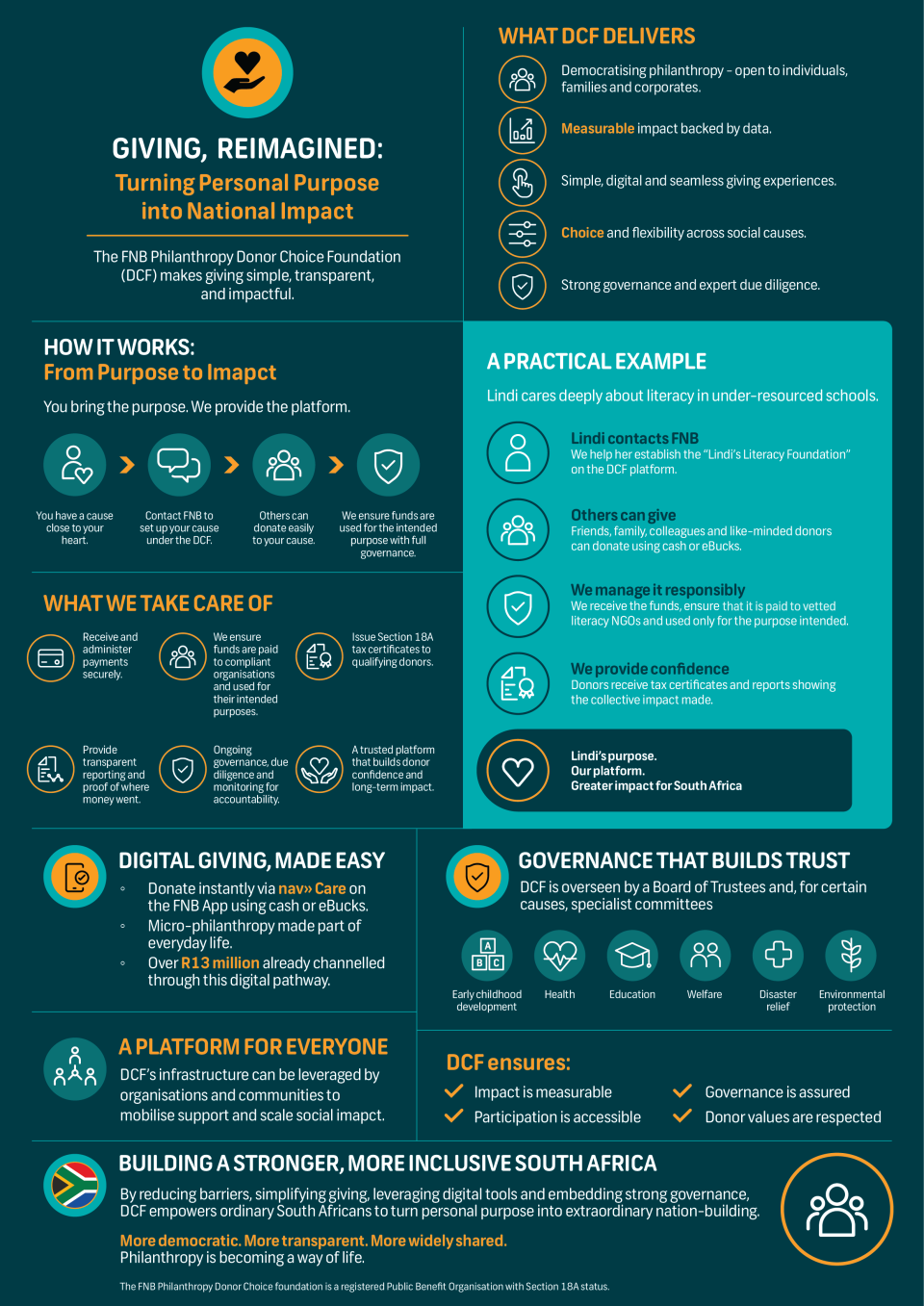
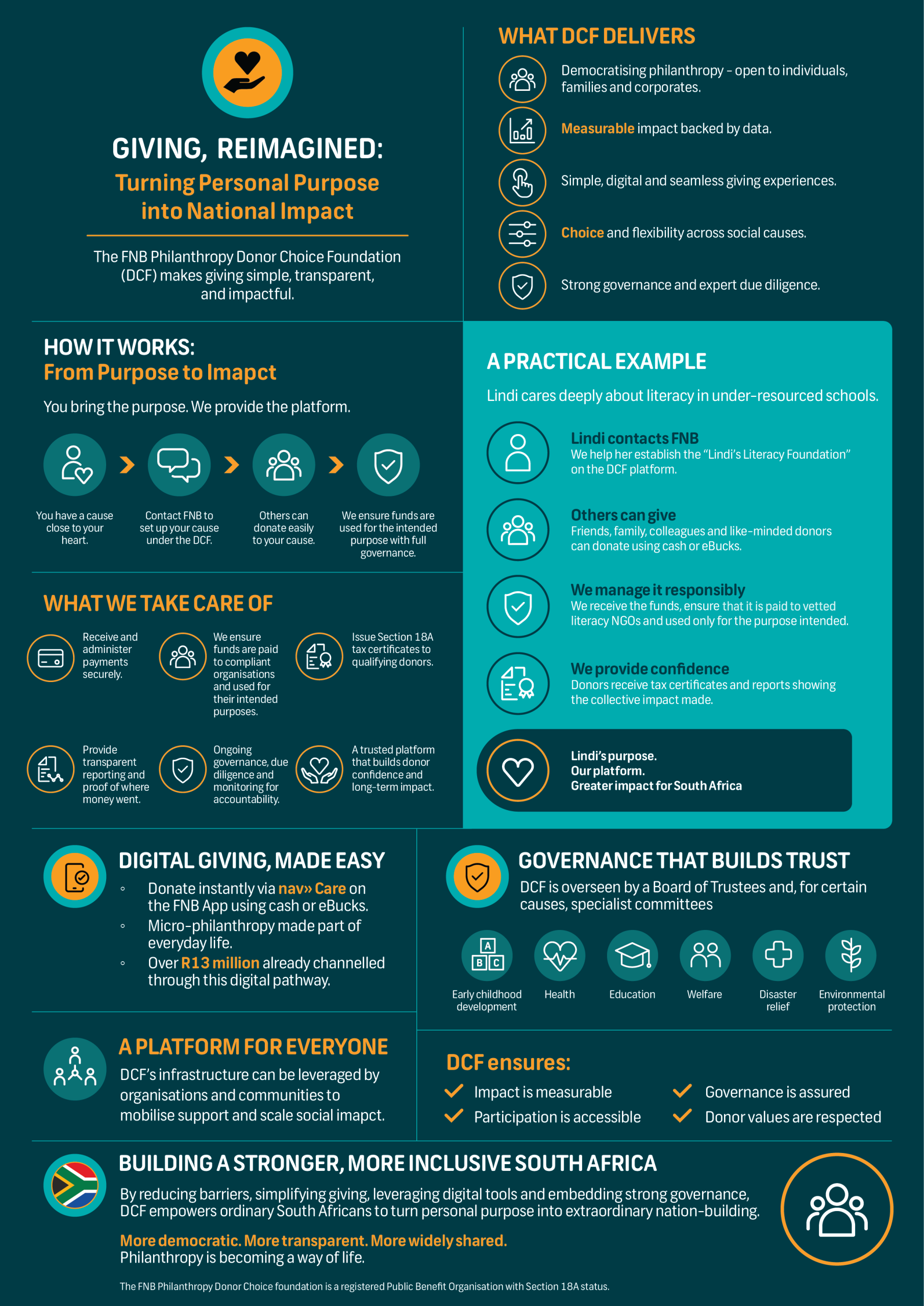
It is against this backdrop that FNB has introduced its Philanthropy Donor Choice Foundation (DCF), a platform designed to support structured, transparent and accountable giving. The foundation enables donors to support causes they care about while relying on a professionally managed governance and administrative framework.
Data from the Donor Choice Foundation indicates that, thus far this year, more than 7 700 donors have used the platform, highlighting the growing demand for solutions that allow individuals to actively choose causes aligned to their values while tracking how funds are allocated.
Rather than requiring donors to establish and manage independent philanthropic vehicles, the Donor Choice Foundation provides the necessary infrastructure to manage donations, vet beneficiary organisations and ensure regulatory compliance. Donations are administered through a controlled framework, with qualifying donors able to receive Section 18A tax certificates.
For example, someone who wants to support a cause in their community — whether it’s helping a local school, funding winter essentials for vulnerable families, or responding to a community crisis — can use the platform without needing to set up a formal foundation from scratch. Through FNB’s Donor Choice Foundation, they are able to create a dedicated cause, invite others to contribute, and rely on an established governance framework to ensure funds are managed responsibly and reach the intended beneficiaries. This approach not only simplifies the process but also makes organised giving more accessible to a wider range of South Africans.
“The intention to help has always been there,” says Stark. “What we consistently see is that people want reassurance that their contributions are being managed responsibly and making a real difference. Removing administrative and governance barriers enables more people to participate in meaningful giving.
The Donor Choice Foundation is overseen by a board of trustees, supported by specialist committees across causes such as early childhood development, elderly support, healthcare, and disaster relief. Other causes, which are also available on FNB’s nav Care feature on its banking app include welfare and humanitarian, conservation and environment, land and housing, and Education. Customers can donate to these causes using cash or eBucks.
To date, more than R13 million has been contributed through the platform, reflecting growing use of accessible and embedded giving solutions.
“We are seeing a shift towards everyday generosity,” Stark adds. “When it is easy to give money and people can see what is happening with their money it can really make a difference”.
This is reflected in Donor Choice Foundation data, which shows that the majority of contributions are made as smaller, more frequent donations, particularly during periods of heightened social need.
As South Africa continues to face complex social and economic challenges, platforms that lower barriers to giving may play an increasingly important role in mobilising private support. While generosity remains deeply rooted in local communities, its effectiveness often depends on the systems that enable intent to translate into action.
SUPPLIED.